
For years, enterprise automation has focused on individual processes: one workflow, one bot, one task at a time.
AI agents are beginning to change that model.
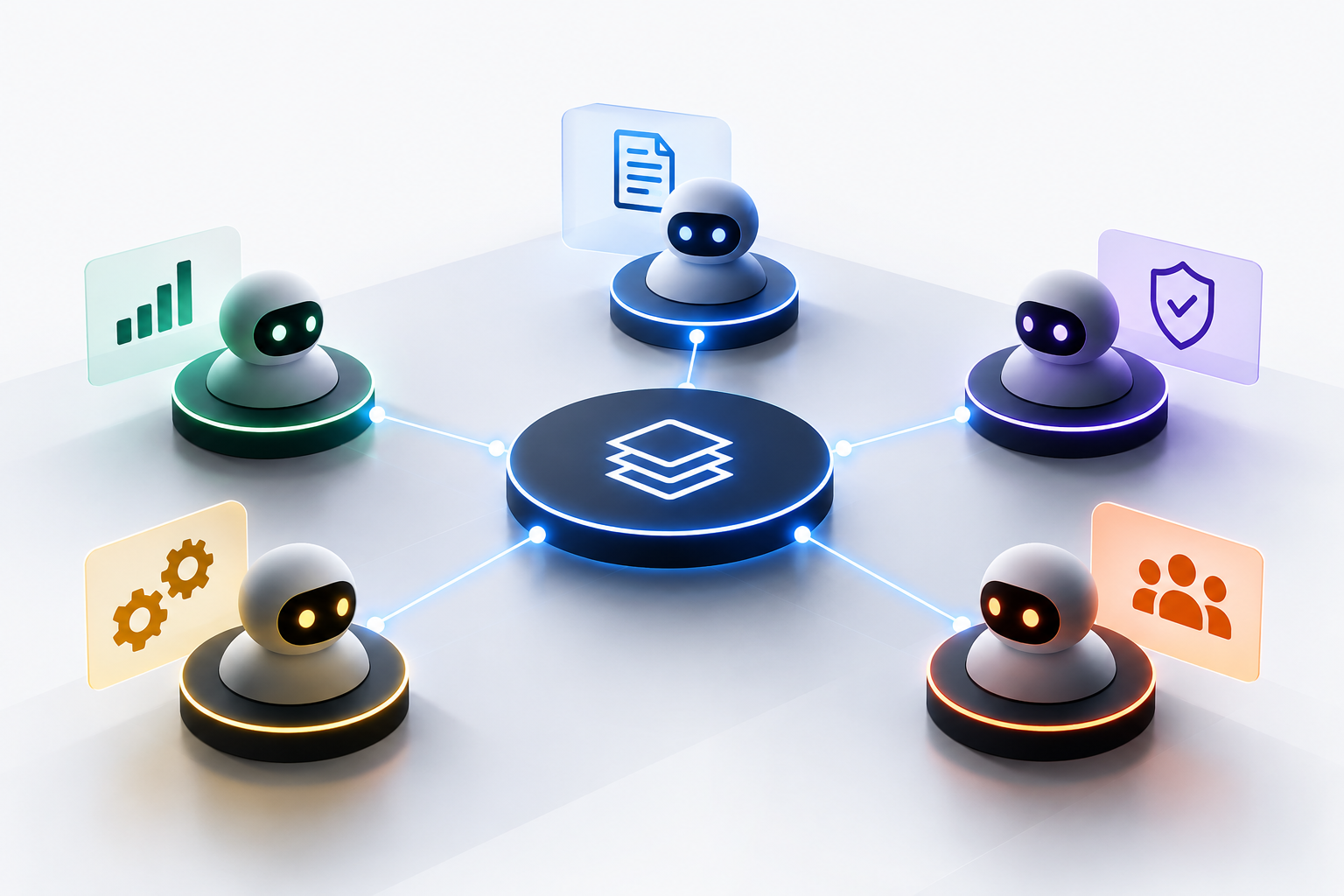
Instead of relying on a single AI system to handle an entire process, organizations can create multiple specialized agents that collaborate, each responsible for a particular task, decision, or area of expertise.
The idea behind multi-agent systems is that AI does not simply perform isolated tasks but coordinates work across a broader business process.
From One AI Agent to a Team of Agents
A single AI agent might be capable of reading documents, retrieving information, making decisions, and interacting with business systems.
But complex enterprise processes rarely involve just one responsibility.
Consider a customer onboarding process. One agent could review submitted documents, another could perform compliance checks, another could create records in internal systems, and another could communicate with the customer.
An orchestration layer coordinates these agents, determines what happens next, and manages the information exchanged between them.
The result starts to resemble a digital team rather than a traditional automation workflow.
Specialization Makes Agents More Useful
One of the biggest advantages of a multi-agent approach is specialization.
Instead of asking one large system to understand every possible scenario, organizations can design agents around specific responsibilities.
For example:
- A Research Agent gathers information from approved sources.
- A Finance Agent analyzes transactions or financial data.
- A Compliance Agent checks policies and regulatory requirements.
- An Operations Agent performs actions across business applications.
- A Communication Agent prepares updates for customers or employees.
Each agent can have its own instructions, permissions, tools, and access to information.
This makes the overall system easier to structure and potentially easier to control.
Orchestration Is the Critical Layer
The real challenge is not creating individual agents. It is making them work together reliably.
Organizations need an orchestration layer capable of deciding which agent should act, what information it receives, what happens when something fails, and when human intervention is required.
Without proper orchestration, multiple agents can introduce more complexity rather than reduce it.
This is where traditional automation principles remain extremely relevant.
Processes still need clearly defined inputs, outputs, responsibilities, exceptions, and controls. AI may introduce greater flexibility, but the underlying process still needs structure.
Human Oversight Still Matters
Multi-agent systems should not mean removing humans from every decision.
For many enterprise processes, the most effective architecture will combine AI agents, deterministic automation, business rules, APIs, and human approvals.
An agent might analyze a contract and identify potential risks, for example, while a lawyer makes the final decision.
Another might investigate an invoice discrepancy and recommend an action while a finance employee approves the payment.
The goal is not necessarily full autonomy. It is to determine where autonomy creates value and where human judgment remains essential.
Governance Becomes Even More Important
As organizations introduce more autonomous systems, governance becomes increasingly important.
Businesses need to understand what each agent can access, what actions it can perform, how decisions are recorded, and how the system behaves when something unexpected happens.
Audit trails, permission boundaries, monitoring, fallback mechanisms, and clear ownership should therefore be designed into the architecture from the beginning.
The more autonomy an agent receives, the stronger these controls need to become.
Conclusion
Multi-agent systems represent an important evolution in enterprise automation.
Instead of automating individual tasks independently, organizations can begin building networks of specialized AI agents that collaborate across entire processes.
But successful implementation will depend on more than the intelligence of the underlying AI models.
Process design, orchestration, governance, integration, and human oversight will ultimately determine whether multi-agent systems create real business value.
The organizations that approach agents as part of a broader automation architecture rather than simply deploying AI wherever possible will be better positioned to turn this technology into reliable operational capability.
Moving Forward
Multi-agent systems become particularly powerful when they can identify problems and coordinate action before those problems affect the business. One area where this potential is especially significant is the supply chain. In the next article, we will explore how AI is capable of eliminating delays before they happen. Using predictive analytics and automation, organizations can anticipate disruptions and respond before they become costly delays.