
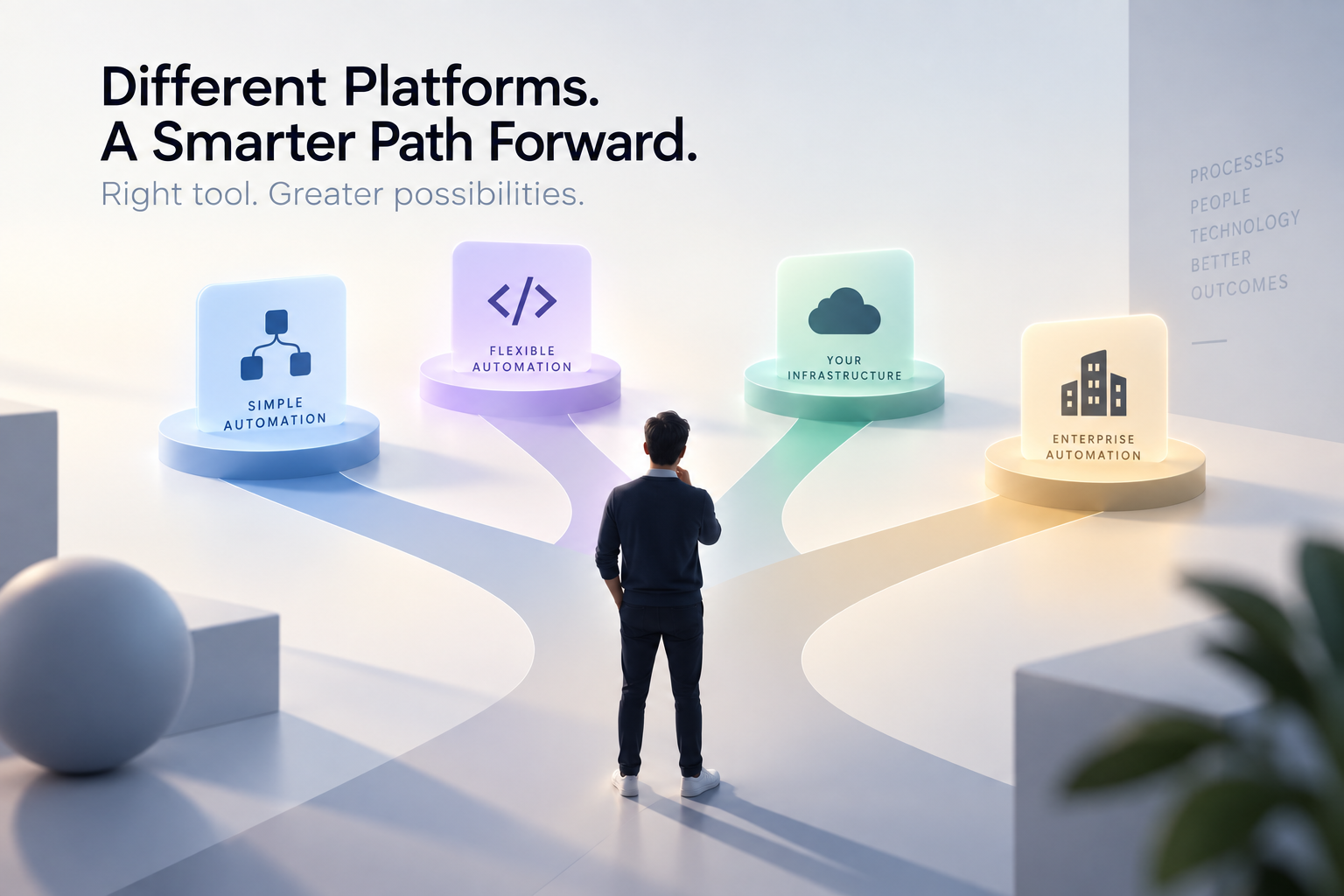
The AI automation market is expanding rapidly.
Some platforms focus on making automation accessible through visual, low-code interfaces. Others provide greater technical flexibility, self-hosting, advanced AI capabilities, or enterprise-level governance.
With so many options available, it is tempting to compare platforms based on features, integrations, or pricing.
But the better question is: What kind of automation capability does the organization actually need?
The answer should start with the process, not the platform.
Different Platforms Solve Different Problems
Consider a relatively simple workflow:
A form is submitted → AI analyzes the information → CRM gets updated → a notification is sent
A visual automation platform may be more than enough.
Now consider a process involving multiple APIs, internal databases, custom business logic, document processing, AI models, and several decision paths. This may require a more flexible workflow engine with stronger technical capabilities.
Enterprise environments introduce additional requirements: security, governance, legacy applications, auditability, monitoring, and controlled deployment.
All three are automation scenarios, but they can require very different platforms.
What Should Businesses Evaluate?
Instead of comparing hundreds of individual features, organizations can focus on a few core areas.
Ease of Use vs. Flexibility
Who will build and maintain the automations?
Business users may benefit from visual interfaces and pre-built connectors, while technical teams may need custom code, API access, reusable components, and more sophisticated logic.
Ease of use can accelerate adoption. Flexibility becomes increasingly important as processes become more complex.
Integration Capabilities
A platform offering thousands of connectors sounds impressive, but the important question is whether it can connect to the systems the organization actually uses.
Beyond native integrations, businesses should consider support for APIs, databases, webhooks, internal applications, and legacy systems.
This becomes particularly important in enterprise environments, where critical systems may not have ready-made connectors.
AI and Agent Capabilities
There is an important difference between adding AI to a workflow and building an AI-driven workflow.
A traditional example might be:
An email is received → AI extracts information → a workflow continues
A more advanced implementation could allow an AI agent to interpret the request, retrieve relevant information, choose from approved tools, execute actions, and escalate exceptions.
As AI becomes more autonomous, capabilities such as permissions, structured outputs, monitoring, approvals, and guardrails become increasingly important.
Governance and Security
Automation often begins with a few workflows and gradually becomes part of the organization’s operational infrastructure.
At that point, governance matters.
Organizations should consider permissions, credential management, audit logs, development environments, error handling, monitoring, and deployment controls.
A platform that works well for ten workflows may not necessarily be suitable when automation expands across the organization.
Keep Humans Where They Add Value
AI automation does not have to mean full autonomy.
In many business processes, a stronger model is:
Automation Prepares → AI Analyzes → Human Reviews → Automation Executes
Contract generation is a good example.
A user could complete a structured form, triggering an automation that selects the appropriate contract template and populates the required information. AI could assist with specific clauses or unstructured content where appropriate.
The contract would then be sent to a lawyer for review and approval before being distributed or sent for signature.
The professional remains responsible for the important decision. The automation removes much of the repetitive administrative work surrounding it.
This principle applies far beyond legal workflows, from finance approvals and procurement to HR and customer service.
Consider the Real Cost of Automation
Subscription price alone rarely tells the full story.
Depending on the platform, costs may depend on executions, individual actions, users, infrastructure, premium integrations, or AI model consumption.
Organizations should therefore consider the total cost of operating the automation, including development, maintenance, monitoring, infrastructure, and expected execution volume.
A platform that looks inexpensive during a pilot can behave very differently when hundreds of workflows and thousands of daily executions depend on it.
One Platform May Not Be Enough
There may not be a single platform that should handle every automation.
An organization might use one technology for desktop and legacy applications, another for cloud integrations, and another layer for orchestrating AI agents.
The objective should not be to force every process into the same tool.
Instead, organizations should build an automation architecture where the right technologies are used for the right problems while maintaining consistent governance and visibility across the environment.
Conclusion
Choosing an AI automation platform should not be a competition between feature lists.
The right choice depends on the processes being automated, the systems involved, the people building and maintaining the workflows, and the level of control the organization requires.
In some cases, a simple visual automation platform will be enough. In others, organizations will need deeper integration capabilities, stronger governance, custom development, or support for increasingly autonomous AI agents.
The key is to avoid designing the automation strategy around a particular tool.
Understand the process → improve it → define the requirements → choose the technology.
Platforms will continue to change. A strong process and automation architecture provides a much more durable foundation.
Moving Forward
As AI automation becomes more sophisticated, the conversation is already moving beyond individual workflows and individual AI agents. The next step is systems where multiple specialized agents work together, each responsible for different tasks, tools, or decisions within the same business process. In the next article, we’ll explore how multi-agent system architectures are orchestrated and operate, where they can provide real business value, and what organizations need to consider before introducing them into enterprise processes.