Legal work has traditionally been difficult to automate.
Unlike highly structured processes such as data entry or invoice processing, legal workflows involve large volumes of documents, complex language, and professional judgment.
Generative AI is changing what is possible. Combined with workflow automation and RPA, AI can now handle significant portions of legal processes while keeping legal professionals in control of the decisions that require expertise.
The objective is not to automate the lawyer. It is to automate the repetitive work surrounding the lawyer.
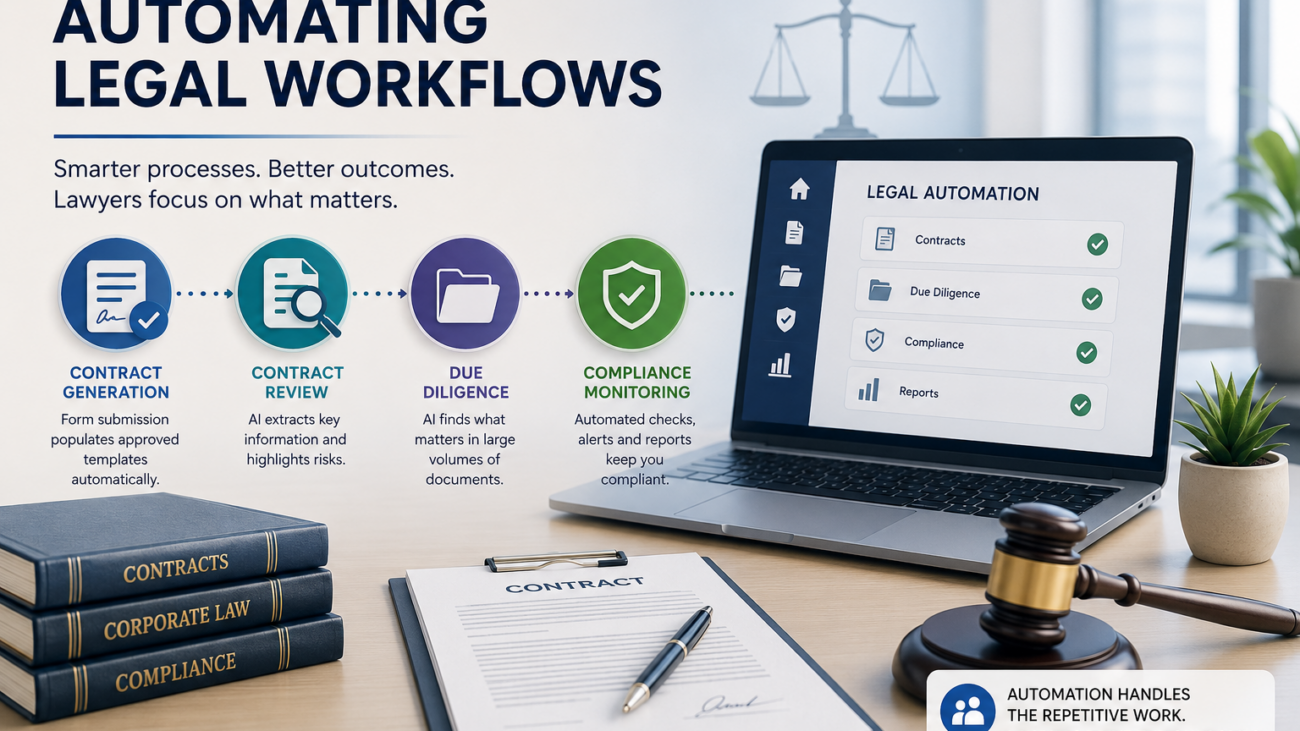
Contract Generation
Not every legal automation requires AI. Contract generation is a good example of how relatively simple automation can remove significant administrative work.
Instead of manually creating contracts from existing templates, a business can provide employees with a structured form containing the information required for the agreement.
For example, the form might collect:
- Customer or supplier information
- Contract type
- Commercial terms
- Effective and termination dates
- Payment conditions
- Other predefined contractual options
Once submitted, an automation can validate the information, select the appropriate approved template, populate the relevant fields, and generate the draft contract automatically.
The generated document is then sent to the lawyer for review and approval before being shared or signed.
This creates a controlled process where automation handles document preparation while the legal professional remains responsible for reviewing the final agreement.
Contract Review
Contract review is another strong opportunity.
AI can perform an initial review of a contract and identify information such as:
- Parties involved
- Effective and termination dates
- Payment terms
- Renewal conditions
- Important obligations
- Liability and confidentiality clauses
Automation can then take the extracted information and update a contract management system, create reminders, or route the document to the appropriate reviewer.
Instead of starting every review from a blank page, legal professionals receive a structured overview and can focus their attention on unusual clauses, risks, and negotiations.
Due Diligence
Due diligence can involve reviewing hundreds or even thousands of documents.
AI can help classify those documents, extract relevant information, summarize content, and highlight areas that require further investigation.
Imagine reviewing hundreds of supplier and customer contracts during an acquisition.
An AI-assisted workflow could identify contracts containing change-of-control provisions, upcoming renewals, unusual termination conditions, or other predefined areas of interest.
The legal team can then prioritize the documents that actually require deeper analysis.
Automation does not replace due diligence. It helps professionals navigate large volumes of information much more efficiently.
Compliance Monitoring
Compliance is another strong candidate because many monitoring activities are repetitive and continuous.
Automation can:
- Identify missing or expired documentation
- Track regulatory and contractual deadlines
- Verify that required approvals have occurred
- Generate compliance reports
- Escalate exceptions for human review
AI can extend these capabilities by analyzing documents and communications that traditional rule-based automation cannot easily interpret.
This allows organizations to move from periodic manual checks toward more continuous compliance monitoring.
Combining AI with Traditional Automation
The most effective legal automation solutions will rarely rely on AI alone.
Consider a contract arriving by email.
Automation collects the document. AI identifies the contract type, summarizes it, and extracts important clauses. Business rules determine the approval path. APIs or RPA update internal systems. A legal professional reviews anything unusual or high-risk.
Once approved, automation stores the document and creates reminders for future obligations.
Each technology handles the part of the workflow it does best.
Human Oversight Remains Essential
Legal workflows demonstrate why human-in-the-loop automation is so important.
Generative AI can make mistakes, miss context, or produce incorrect interpretations. Organizations therefore need clear boundaries around what AI can perform independently and what requires professional review.
The higher the potential legal or financial impact, the stronger those controls should be.
Security and privacy are equally important. Legal documents frequently contain confidential or commercially sensitive information, so organizations must understand where information is processed, who can access it, and how AI-generated actions and outputs are monitored.
Start with the Process
Organizations should avoid beginning with the question:
“Where can we use AI?”
A better question is:
“Where is unnecessary time being spent in our processes?”
Map the workflow, identify repetitive activities and bottlenecks, and then select the appropriate technology.
Some steps may require AI. Others may be better suited to RPA, APIs, or traditional workflow automation.
The biggest opportunity is not removing legal professionals from the process. It is allowing them to spend less time preparing documents, searching through contracts, copying information, and tracking routine activities rather than evaluating risk, negotiating agreements, and advising the business.
Moving Forward
In the next article, we’ll explore different AI automation platform options. We’ll examine how businesses should evaluate automation platforms based on integration capabilities, AI support, governance, scalability, technical complexity, and the processes they actually need to automate.