
Before automating a business process, organizations need to understand how it works. Yet, understanding a process is not always straightforward. What employees describe as the standard workflow may differ significantly from what happens in practice.
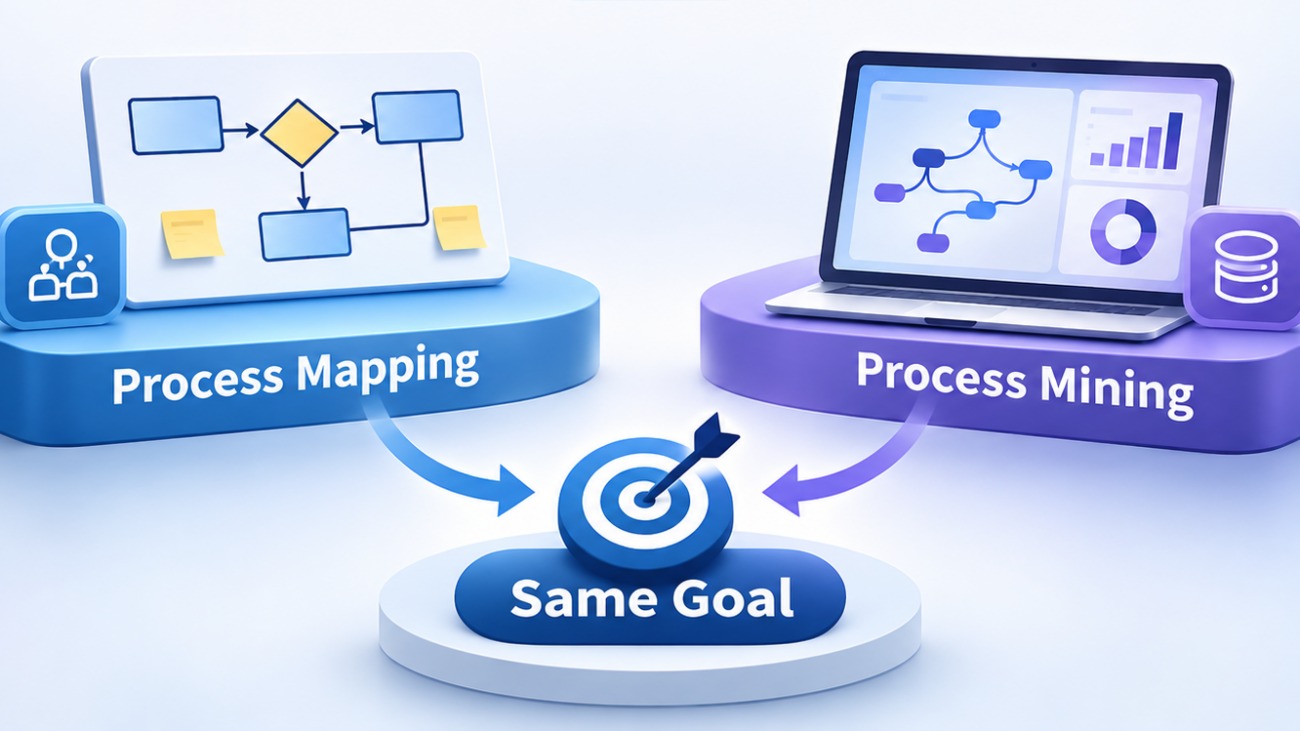
Two approaches help bridge this gap: Process Mapping and Process Mining. While both aim to improve operational efficiency, they offer different perspectives on how work gets done.
Understanding Process Mapping
Process Mapping is the practice of visually documenting the steps, decisions, and interactions involved in a business process.
Through workshops, interviews, and direct observation, organizations can create a structured representation of their workflows.
Process Mapping helps organizations:
- Identify unnecessary steps and bottlenecks.
- Clarify responsibilities and decision points.
- Standardize procedures across departments.
- Discover opportunities for optimization and automation.
For example, mapping an invoice approval process might reveal that multiple departments perform the same validation, creating unnecessary delays.
Its greatest strength is the human perspective: understanding not only what happens, but also why certain activities exist.
Understanding Process Mining
Process Mining takes a data-driven approach. Instead of relying primarily on interviews and observations, it analyzes event logs generated by systems such as ERP, CRM, and workflow platforms.
These records allow organizations to reconstruct how processes actually execute.
Process Mining helps organizations:
- Discover actual process flows and variations.
- Measure processing times and identify recurring delays.
- Detect deviations from established procedures.
- Monitor performance and compliance over time.
For example, Process Mining might reveal that 30% of invoices follow an unexpected approval route, increasing processing times and operational costs.
Its greatest advantage is providing objective, measurable insights based on real system activity.
Process Mining vs. Process Mapping: Key Differences
Although both approaches support process improvement, they differ in several important ways.
1. Source of Information
Process Mapping relies on interviews, workshops, and observations to document workflows. Process Mining analyzes digital event logs to reconstruct how processes actually execute.
2. Perspective
Process Mapping captures business knowledge, responsibilities, and intended workflows. Process Mining reveals actual execution patterns, including unexpected variations and deviations.
3. Level of Detail
Process Mapping explains decisions, exceptions, and business context. Process Mining provides measurable insights into processing times, bottlenecks, and process performance.
4. Process Coverage
Process Mapping can document both digital and manual activities. Process Mining primarily analyzes activities recorded in information systems, making data availability and quality essential.
5. Continuous Improvement
Process Mapping typically requires periodic reviews and updates. Process Mining can support continuous monitoring, allowing organizations to identify emerging inefficiencies as they occur.
Neither approach is inherently better. Their effectiveness depends on the organization’s processes, systems, and objectives.
Why Combining Both Delivers Better Results
The real value emerges when organizations use Process Mapping and Process Mining together.
Process Mapping provides context, business rules, and an understanding of human decisions. Process Mining validates those assumptions against operational data, revealing discrepancies and hidden inefficiencies.
Consider a customer onboarding process. Mapping might identify five standard steps, while mining reveals that certain applications repeatedly move backward between departments.
Together, these insights help organizations understand both the cause of the problem and its measurable impact.
This combined approach creates a stronger foundation for automation by ensuring that organizations improve processes before introducing new technology.
Conclusion
Process Mapping and Process Mining share a common objective: making business processes more transparent, efficient, and reliable.
One provides the human and operational perspective, while the other brings data-driven evidence.
Successful automation starts with understanding the process, not simply digitizing existing inefficiencies.
Organizations that combine these approaches can make better decisions, prioritize high-impact improvements, and build automation solutions that deliver sustainable value.
Moving Forward
Once organizations understand and optimize their processes, the next challenge is choosing how to automate them.
Should they develop custom solutions internally or invest in existing automation platforms?
In the next article, “The Build vs. Buy Decision in Automation: A Framework for Leaders,” we’ll explore the key considerations that help business leaders select the right approach for their automation strategy.