j86r7paWRd68iEwERDsqcA@2k

The Future of Work: Human-AI Collaboration in the Digital Enterprise

The workplace is changing as organizations adopt automation and artificial intelligence to improve efficiency and service quality. Yet despite the growing role of technology, the future of work is not about replacing people with machines. Instead, it is about creating a collaborative environment where humans and intelligent systems work together.

In a digital enterprise, automation tools and AI systems handle repetitive and data-heavy activities, while employees focus on judgment, creativity, and problem-solving. This combination creates a stronger, more efficient workplace where both technology and people contribute their strengths.

Robotic Process Automation (RPA) has already demonstrated how software robots can take over routine digital tasks such as data entry, report preparation, and transaction processing. These automations free employees from repetitive work and allow them to concentrate on activities that require human insight and interaction.

Human-AI collaboration builds on this concept by combining automation with intelligent decision support.

How Humans and AI Work Together

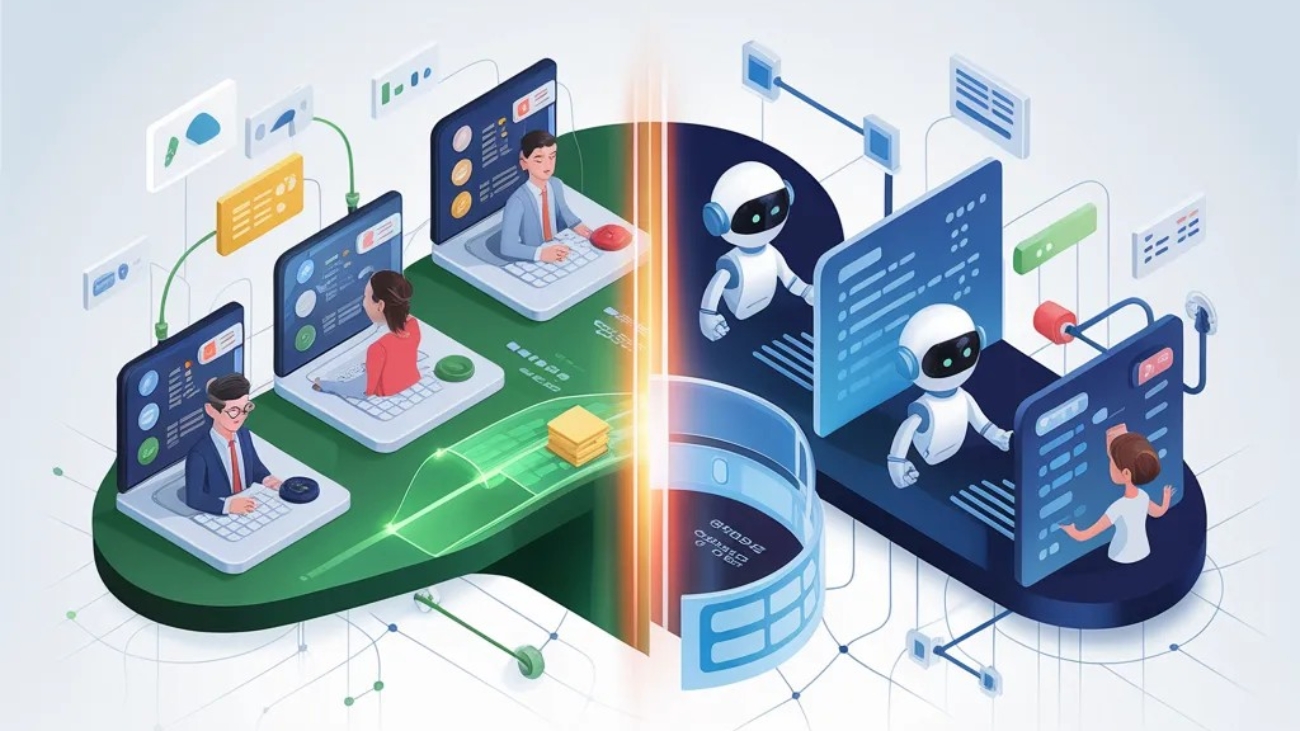
When organizations integrate AI and automation into their daily operations, they create a cooperative system where each side complements the other.

Automation handles repetitive work

  • Processing large volumes of data
  • Moving information between systems
  • Performing standardized administrative tasks
  • Running routine reports

These are tasks that follow clear rules and require consistency, making them ideal for automation.

Employees focus on higher-value activities

  • Interpreting results and making decisions
  • Solving unusual or complex cases
  • Communicating with customers and partners
  • Improving processes and services

This shift allows employees to contribute more strategically rather than spending time on manual activities.

Practical Examples of Collaboration

Human-AI collaboration is already appearing in many departments:

Customer Service: Automation gathers customer information and prepares case details before a representative responds. The employee can then focus on resolving the issue rather than searching for data.

Finance: Automations collect and organize financial data, while analysts review results, identify patterns, and make recommendations.

Human Resources: Automation assists with onboarding tasks and system access setup, allowing HR teams to concentrate on employee engagement and development.

Operations: Automated systems track transactions and generate alerts when exceptions occur. Staff review these alerts and take the appropriate action.

These examples show that automation does not remove the human role; it strengthens it.

Benefits of a Collaborative Digital Workplace

Organizations that adopt human-AI collaboration often experience several advantages:

  • Higher productivity: Routine tasks are completed faster and with fewer errors.
  • Better decision-making: Employees have faster access to reliable information.
  • Improved employee satisfaction: Teams spend less time on repetitive work.
  • Greater scalability: Automated systems can handle increasing workloads without requiring proportional staff increases.

Automation technologies can operate continuously and maintain consistent performance, which supports employees and increases overall efficiency.

Preparing the Workforce for Collaboration

To fully benefit from human-AI collaboration, organizations should focus on several important areas:

Training and awareness as employees need to understand how automation works and how it supports their roles.

Process improvement since automation works best when processes are clearly defined and structured.

Change management while introducing new technology requires open communication and employee involvement.

Leadership support as leaders must demonstrate that automation is a tool that supports employees rather than replacing them.

When these elements are in place, organizations can create a balanced and productive digital workplace.

Conclusion

The future of work is not defined by technology alone. It is defined by how well organizations combine human expertise with intelligent systems.

Automation and AI provide speed, consistency, and the ability to process large volumes of information. People contribute creativity, judgment, and interpersonal skills. When these strengths work together, organizations become more efficient, adaptable, and ready for the demands of the digital economy.

Moving Forward

In the next article, we will explore how leaders can drive Digital Transformation. We will examine how leadership mindset, communication, and organizational culture influence the success of digital transformation initiatives.

ethical AI in automation. png

Ethical AI in Automation: Balancing Innovation with Responsibility

Artificial Intelligence is no longer a distant concept. It is already embedded in the tools that automate invoices, process customer requests, screen applications, and generate reports. When combined with automation, AI allows organizations to go beyond simple rule-based tasks and handle more complex decisions.

But as automation becomes smarter, an important question arises: just because we can automate something, should we?

Ethical AI in automation is about making sure technology supports people, protects data, and strengthens trust. It ensures that efficiency gains do not come at the cost of fairness or accountability.

Why Ethics Matters in AI-Driven Automation

Automation can process thousands of transactions in minutes. AI can analyze patterns and recommend actions. Together, they create powerful systems that influence real outcomes: loan approvals, hiring decisions, insurance claims, compliance checks, and more.

Without clear guidelines, these systems can introduce risks such as the following:

  • Bias in decision-making: If AI is trained on biased historical data, it may repeat or amplify unfair patterns.
  • Lack of transparency: Employees and customers may not understand how automated decisions are made.
  • Data privacy concerns: Automation often relies on large volumes of sensitive information.
  • Over-automation: Removing human oversight from critical processes can lead to errors going unnoticed.

Ethical AI is not about slowing innovation. It is about making sure innovation is sustainable and trusted.

Key Principles for Responsible Automation

Organizations do not need complex theories to act responsibly. They need practical steps embedded in their digital transformation strategy.

1. Keep Humans in the Loop AI-powered automation should support human decision-makers, not replace them in high-impact scenarios. For example, an AI system can flag unusual transactions, but a human can review and confirm the final action. This balance reduces risk and builds confidence in the system.

2. Ensure Transparency Employees should understand when they are interacting with an automated process. Clear communication about how decisions are supported by AI reduces confusion and resistance. Documentation of automated workflows is equally important for internal control and audits.

3. Prioritize Data Protection Automation projects must include strict access controls, encryption, and monitoring. Sensitive data should only be available to those who truly need it. Responsible data management is the foundation of ethical AI.

4. Regularly Test for Bias and Errors AI models and automated workflows should be reviewed periodically. Are certain groups consistently flagged for review? Are error rates increasing in specific scenarios? Ongoing monitoring ensures that small issues do not grow into major problems.

5. Define Clear Accountability Every automated process should have an owner. When something goes wrong, it must be clear who is responsible for investigating and correcting it. Automation does not remove accountability; it shifts how it is managed.

The Role of Leadership

Ethical AI is not only a technical topic. It is a leadership responsibility. Executives and managers must set expectations for responsible automation from the beginning.

This includes:

  • Establishing internal guidelines for AI and automation projects
  • Involving compliance and legal teams early
  • Training employees on how automation works
  • Encouraging open discussion about concerns

When ethics is part of the planning phase, it becomes a strength rather than a limitation.

Building Trust Through Responsible Innovation

Customers are increasingly aware of how their data is used. Employees are paying attention to how automation affects their roles. Organizations that approach AI responsibly send a strong message: efficiency matters, but people matter more.

Responsible automation leads to:

  • Strong intelligence generates customer trust
  • Reduced regulatory risk
  • Better employee acceptance
  • More stable, long-term digital transformation outcomes

AI alongside automation can significantly improve accuracy, speed, and scalability. However, sustainable success depends on thoughtful implementation. Ethical AI ensures that automation supports growth without compromising integrity.

Conclusion

Ethical AI in automation is about balance. It combines technological progress with human judgment, strong governance, and respect for data privacy.

Organizations that integrate responsibility into their automation strategy will not only improve performance but also build lasting trust with customers and employees. In a world where digital processes increasingly shape decisions, responsible AI is no longer optional; it is essential.

Moving Forward

In the next article, we will explore the future of work and the collaboration of humans and AI in the digital enterprise. We will examine how employees and intelligent systems can work side by side, creating workplaces where technology enhances human potential rather than replacing it.

Dkqnyb5sRkeBaprkUYwWVw@2k

The Role of Cloud in Scaling Digital Transformation

Cloud computing has become a key ingredient in how organizations approach digital transformation today. While digital tools like Robotic Process Automation (RPA) and AI are getting most of the attention, none of these can reach their full potential without the flexibility, scalability, and accessibility offered by the cloud.

So what does the cloud really contribute to a company’s ability to grow its digital capabilities, and why is it such a critical part of long-term success?

What the Cloud Brings to the Table

Here’s how the cloud supports digital transformation in practical terms:

  • Scalability on Demand: Traditional infrastructure requires investment in servers, storage, and maintenance. Cloud platforms offer resources that scale up or down as needed, allowing businesses to respond quickly to growth or seasonal demand without overcommitting.
  • Lower Barrier to Entry for Innovation: With cloud services, small and medium-sized businesses can access advanced technologies like automation, AI, and data analytics without major upfront investments. This evens the playing field and encourages experimentation.
  • Fast Deployment of Digital Tools: Deploying new systems on-premises can take months. Cloud platforms offer pre-configured environments, APIs, and integrations that significantly speed up implementation.
  • Centralized Data, Decentralized Teams: The cloud enables real-time access to data and applications from anywhere. This supports remote work, global collaboration, and continuity during disruptions.
  • Security and Compliance Built-In: Most reputable cloud providers offer strong security controls and compliance features by default. This allows businesses to focus on building value rather than setting up their own protection measures from scratch.
  • Support for Automation: Tools like RPA, machine learning, and low-code platforms work best when cloud-hosted. They can scale quickly and integrate with other cloud-native tools, boosting the impact of automation across departments.

Why It Matters More as You Grow

As digital transformation progresses, the need for speed, flexibility, and integration increases. The cloud enables businesses to:

  • Launch new services faster
  • Consolidate and analyze large volumes of data
  • Adapt IT environments without major capital investments
  • Build and connect systems across geographies

In short, cloud infrastructure is no longer just a hosting option, it’s an enabler of continuous improvement.

A Realistic Path to Digital Growth

Not every organization starts out cloud-first. Many have legacy systems that aren’t immediately compatible with cloud platforms. But even in those cases, a hybrid approach where some applications run in the cloud while others stay on-prem can offer noticeable benefits.

Here’s a simple way to start:

  1. Identify processes or applications that are high-maintenance or slow to scale.
  2. Evaluate whether these can be moved to cloud-based alternatives.
  3. Use the cloud to test new technologies like automation or analytics tools in controlled pilots before scaling up.

Conclusion

The cloud isn’t just about storage or hosting; it’s about giving businesses the flexibility to grow smarter. As more organizations look to automate processes, personalize services, and work more collaboratively, the cloud is the backbone that makes those ambitions achievable.

Moving Forward

In the next article, we’ll explore how automation can evolve responsibly. “Ethical AI in Automation: Balancing Innovation with Responsibility” will cover how organizations can apply AI thoughtfully, respecting privacy, transparency, and fairness while still reaping efficiency gains.

a-sleek-infographic-poster-showcasing-mo_I0rvFtFnR8WyAbmlw9Pseg_gH-tMM4oSGaOc_j5ejgVYw

Automation in Finance: Beyond RPA to Predictive Analytics and AI Insights

The finance department has long been seen as the stronghold of structure, routine, and regulation. It’s no surprise, then, that automation found one of its earliest and strongest footholds here through Robotic Process Automation (RPA). Automating tasks like invoice processing, reconciliations, and reporting has delivered significant efficiency and accuracy gains. But the real transformation starts when we move beyond RPA and into the territory of predictive analytics and artificial intelligence (AI).

While RPA handles repetitive rule-based tasks, finance leaders are now looking at what’s next. Predictive analytics and AI can help answer deeper questions: What will our cash flow look like in 90 days? Where are the risks hiding in our financial operations? Which customers are likely to default?

Here’s how these technologies are expanding the value of automation in finance:

Moving from Reactive to Proactive

Traditional finance functions often respond to what already happened. Predictive analytics, however, allows teams to anticipate outcomes based on patterns in historical and real-time data. For example, by analyzing customer payment behaviors, finance teams can forecast late payments and adjust credit terms or cash flow plans accordingly.

AI-driven tools can also spot trends across accounts payable and receivable, helping identify potential fraud, duplicate payments, or unusual vendor activity before they cause damage.

Practical Use Cases of Predictive Analytics and AI in Finance

  • Cash Flow Forecasting: AI tools ingest large volumes of historical and real-time data to forecast future cash positions with more precision than spreadsheets.
  • Credit Risk Assessment: Machine learning models analyze customer behavior, market data, and payment history to better predict risk and inform lending or credit decisions.
  • Expense Management: Predictive models help identify seasonal patterns or outlier spending, supporting better budget planning and cost control.
  • Anomaly Detection: AI systems can automatically detect irregular transactions or accounting entries that might require deeper investigation.
  • Decision Support: CFOs are increasingly using AI-powered dashboards that not only visualize data but also recommend actions based on detected patterns.

Why This Matters

Finance isn’t just about balancing books anymore. It plays a strategic role in guiding business decisions. Automation frees up time, but it’s predictive analytics and AI that bring new intelligence to the table. These tools help finance leaders move from month-end reporting to real-time decision-making.

And the benefits go beyond the finance team. Smarter financial forecasting improves overall business planning, strengthens investor confidence, and helps align resources more effectively.

What to Keep in Mind

Adopting predictive tools and AI requires more than just new software. It’s important to:

  • Ensure high-quality, accessible data. AI tools are only as good as the data they’re fed.
  • Start with a clear use case to show early wins and build internal support.
  • Involve IT and data teams early to ensure smooth integration with existing systems.
  • Train finance staff to interpret AI-generated insights and use them effectively.

Conclusion

The finance function is in the middle of a major shift, from being automation-driven to insight-driven. RPA laid the groundwork by handling routine tasks. Now, predictive analytics and AI are stepping in to help finance teams uncover hidden patterns, forecast more accurately, and make smarter decisions. It’s not just about doing things faster! It’s about doing the right things at the right time.

Moving Forward

In our next article, we’ll look at how cloud technology helps scale digital transformation across departments, making modern automation and analytics tools more accessible to businesses of all sizes.

9Av_mrxrRVCrdegWcPDYxg

The Human Side of Digital Transformation: Driving Adoption and Engagement

Digital transformation is not just a matter of technology, it’s equally about people. While companies often focus on new systems and tools, successful transformation hinges on how employees engage with these changes. When organizations overlook the human side of digital transformation, even the best tools can fall flat. So how can companies ensure that their people are not only on board but actively participating in the process?

Understanding the Human Factor

Digital tools like automation, artificial intelligence, and analytics can dramatically improve efficiency. But introducing them often means changing workflows, habits, and sometimes entire job roles. This shift can create uncertainty or resistance if not managed well.

That’s why the first step in any transformation should include clear communication. People need to understand why the change is happening, how it benefits them, and what support they will receive along the way. Framing technology as an aid rather than a threat can ease fears and build trust.

Practical Ways to Encourage Adoption

  1. Involve Employees Early Give people a voice during the planning stages. Ask for their input on what tasks could benefit from automation and where they see inefficiencies. When employees feel involved, they’re more likely to support the outcomes.
  2. Provide Ongoing Training One-time workshops aren’t enough. Offer regular training and easy-to-access resources. Focus on practical use rather than technical details which employees don’t need to become experts in; they just need to feel confident using new tools.
  3. Appoint Digital Champions Select tech-savvy team members as internal ambassadors. They can act as the go-to contacts for questions and troubleshooting, helping to build peer-to-peer support and reduce pressure on IT teams.
  4. Celebrate Early Wins Highlight quick successes, such as a department saving time by automating a report. These stories boost morale and show others what’s possible.
  5. Align Technology with Real Needs Ensure that new tools solve actual problems. Avoid rolling out technology for its own sake. When solutions clearly make work easier, people are more likely to use them.
  6. Encourage Feedback and Adaptation Digital transformation is not a one-and-done event. Keep channels open for feedback and make adjustments where needed. This continuous improvement loop builds confidence and accountability.

Why Engagement Matters

People who feel included and supported during transformation are more productive and adaptable. When employees embrace new tools, companies benefit from smoother transitions, faster implementation, and better return on investment.

More importantly, strong engagement fosters a culture of innovation. It empowers teams to suggest improvements, share knowledge, and use digital tools to their full potential.

Conclusion

Digital transformation succeeds when technology and people move together. By focusing on open communication, continuous learning, and real-world value, companies can turn employees into active participants and not passive recipients of the change. It’s not just about installing software; it’s about building a workforce that’s ready and willing to grow with it.

Moving Forward

Next, we’ll explore what low-code and no-code platforms are and how they help non-technical staff take part in automation without needing to write code.

Yd_ECvvwSy6nf3K6_lE5Qg

From Data to Decisions: Leveraging AI in Business Process Automation

Artificial Intelligence (AI) has moved from being a buzzword to a practical tool that organizations use to improve the way they work. When integrated into automation, AI helps companies move beyond just automating repetitive tasks. It adds the ability to analyze data, recognize patterns, and make decisions that were once reserved for humans. This shift is enabling businesses to work smarter, not just faster.

AI doesn’t replace automation; it enhances it. Traditional automation relies on fixed rules and logic, which works well for predictable tasks. But what about processes that require decision-making, adaptation, or learning from patterns? That’s where AI steps in, turning static workflows into intelligent systems that can adapt and improve over time.

Here’s how AI is making a difference in business process automation:

1. Smarter Data Handling AI can sift through massive amounts of data in seconds. Whether it’s emails, invoices, customer feedback, or sensor data, AI helps structure and interpret this information. This means businesses no longer need to rely on manual input or data sorting, speeding up tasks and reducing the chance of errors.

2. Intelligent Decision-Making AI-powered systems can make decisions based on historical data and defined goals. For example, in customer support, AI can prioritize inquiries, suggest responses, or even handle simple issues autonomously. In finance, it can assess loan applications based on risk patterns, not just checklists.

3. Continuous Process Improvement With machine learning, automated systems can learn from past actions and outcomes. Over time, this allows the process to become more efficient and accurate without human intervention. Think of it as automation that doesn’t just follow instructions—but evolves.

4. Personalization at Scale AI allows for tailored experiences across customer service, marketing, and more. By analyzing customer behavior and preferences, AI can adjust workflows to offer more relevant interactions, without manual tweaking for each individual.

5. Better Resource Allocation AI can help forecast demand, workload, and capacity, allowing organizations to better allocate resources. This is especially helpful in sectors like logistics, customer service, and manufacturing, where timing and efficiency are crucial.

What Businesses Should Keep in Mind

AI-enhanced automation isn’t plug-and-play. Success depends on having clean data, clear goals, and a solid understanding of your processes. It’s also important to ensure that employees are trained to work alongside these tools, not around them.

For most organizations, a good first step is identifying a high-volume, data-heavy process that’s already being automated. Adding AI to that process, such as using machine learning for invoice categorization or chatbots in customer service, can demonstrate real value quickly.

Conclusion

The combination of AI and business process automation represents a meaningful step forward. It shifts automation from doing work faster to doing work better. With AI, businesses can turn data into decisions, reduce bottlenecks, and improve outcomes across departments.

Moving Forward

In the next article, we’ll explore the human side of digital transformation. We’ll look at how to bring people along when introducing new technologies—because even the smartest automation won’t succeed without employee buy-in.

Screenshot 2025-10-29 164350

Hyperautomation Explained: What It Is and Why It Matters for the Enterprise

These days, most businesses have started using automation in one form or another, usually to handle repetitive, time-consuming tasks. But there’s a bigger opportunity on the table now. It’s called hyperautomation, and it’s about going beyond just automating individual tasks to connecting entire workflows using a mix of technologies like AI, analytics, and RPA.

Instead of focusing on single tasks, it connects multiple technologies to automate complete processes across departments. Think of it as the natural next step after RPA, combining tools like artificial intelligence (AI), machine learning, process mining, and low-code platforms to build smarter and more adaptable systems.

What Makes Hyperautomation Different?

Hyperautomation is not a single tool. It’s a strategy. Here’s what sets it apart:

  • Multiple Technologies Working Together: It doesn’t rely only on robots. Hyperautomation integrates RPA with AI, natural language processing (NLP), analytics, and more to handle complex workflows.
  • Automation at Scale: Instead of focusing on isolated tasks, hyperautomation looks at end-to-end processes. This allows companies to automate entire functions, like onboarding new employees or managing vendor payments.
  • Continuous Improvement: Using process discovery and analytics tools, hyperautomation identifies automation opportunities over time, allowing businesses to refine and expand their strategies as needs evolve.

Key Benefits of Hyperautomation

Hyperautomation offers several practical advantages for enterprise operations:

  • Faster Decision-Making: With AI analyzing data in real-time, companies can respond more quickly to changes and make better decisions without relying solely on human input.
  • Improved Accuracy: Automation reduces the chance of human error, especially in data entry, compliance, and reporting tasks.
  • Increased Efficiency: Employees are freed from routine tasks, allowing them to focus on higher-value work that requires human judgment or creativity.
  • Scalability: As the business grows, hyperautomation makes it easier to adapt processes and maintain performance without hiring additional staff.
  • Better Customer Experience: From chatbots handling service inquiries to automated order tracking, customers benefit from faster and more consistent interactions.

Where Enterprises Use Hyperautomation Today

Some examples of hyperautomation in action include:

  • Finance: Automating invoice processing, financial reporting, and fraud detection using AI alongside traditional RPA tools.
  • Human Resources: Streamlining recruitment, onboarding, and employee data updates across multiple systems.
  • Supply Chain Management: Enhancing visibility, automating order management, and predicting demand with the help of analytics and machine learning.
  • Customer Service: Integrating chatbots with backend systems to solve queries, update records, and route issues effectively.

Getting Started: What Enterprises Should Consider

Before jumping in, companies should:

  • Evaluate current workflows to identify which areas can benefit most from extended automation.
  • Involve IT and business teams to ensure solutions are aligned with real business needs and technical capabilities.
  • Choose flexible platforms that allow integration of multiple technologies rather than relying on a single vendor.
  • Start small, with pilot projects that demonstrate value, and then scale gradually.

Final Thoughts

Hyperautomation helps enterprises move beyond simple task automation to a connected, intelligent approach that improves overall business performance. It’s not about replacing people, it’s about using technology to support them in smarter ways.

Moving Forward

In the next article, we’ll explore how artificial intelligence can turn raw business data into useful insights.

a-modern-infographic-style-illustration-_etW7BcA3SDy03TVfUva0zw_GSGjrMMASmWXV54niYt-iw

Intelligent Automation: Blending RPA with AI for Smarter Workflows

In the past, automation meant handling repetitive, rule-based tasks with software robots. While that still holds true, things have evolved. Today, the real value lies in combining Robotic Process Automation (RPA) with Artificial Intelligence (AI) to handle more complex and dynamic work. This combination is often referred to as “intelligent automation”, a practical solution that helps businesses operate faster, with greater accuracy and more adaptability.

When RPA and AI are brought together, the result is much more than just automated processes. It’s about smarter workflows that think, learn, and improve over time.

Why Combine RPA with AI?

RPA is excellent for automating structured, repetitive tasks, think data entry, invoice processing, or report generation. However, it has limitations. It can’t understand context, make predictions, or process unstructured data on its own.

That’s where AI steps in. AI adds capabilities like:

  • Machine Learning (ML): Allows systems to learn from data and make better decisions over time.
  • Natural Language Processing (NLP): Enables systems to read, interpret, and respond to human language.
  • Computer Vision: Helps machines interpret visual information, such as scanned documents or images.

Together, these tools can automate tasks that were previously too complex for traditional RPA.

How Businesses Benefit from Intelligent Automation

Blending RPA and AI leads to smarter automation with broader applications. Here’s how it helps:

  • Smarter Decision-Making: AI enables bots to make decisions based on patterns and predictions, rather than just fixed rules.
  • Improved Customer Service: Chatbots can understand and respond to queries using NLP, handling customer issues round-the-clock.
  • Data-Driven Insights: ML models can analyze data and uncover insights, while RPA can automatically trigger actions based on those insights.
  • Handling Unstructured Data: AI can process emails, PDFs, images, and voice commands turning messy data into actionable input for bots.

Practical Examples

  1. Invoice Processing: AI reads and extracts data from invoices, even if the formats vary. RPA then inputs that data into accounting systems without errors.
  2. Email Management: AI categorizes and prioritizes incoming emails. RPA routes them to the right departments or responds automatically.
  3. Employee Onboarding: AI can verify documents and recognize patterns in applications, while RPA ensures new hires get system access, ID cards, and welcome emails without delays.

Challenges to Keep in Mind

While intelligent automation offers clear benefits, it’s important to approach it strategically:

  • Not all tasks need AI. Use AI where it adds value, such as understanding, decision-making, or prediction.
  • Start small. Test combinations in specific workflows before expanding.
  • Make sure your systems can support AI models and integrate smoothly with RPA tools.

Finally, it’s very important to keep in mind that at least for the time being, AI can’t replace humans. It’s perfectly fine to use these technologies to become more productive and efficient, but it’s crucial that a human confirms what has been developed to make sure the result is accurate, correct and ready to be shared publicly.

Moving Forward

As automation technologies mature, businesses have a real opportunity to make their workflows smarter, not just faster. By blending the reliability of RPA with the adaptability of AI, companies can improve how they operate in a way that feels intelligent, not robotic. In the next article, we’ll break down hyperautomation. We’ll show how it connects to what’s described in this article and how it can streamline the entire automation strategy of a business.

vniRwZNyR3qOVrRCb5RaVw

The Role of Automation in Digital Transformation Strategies

Digital transformation is no longer just an initiative for tech-focused companies—it’s a fundamental requirement for any organization that wants to stay relevant and competitive. At the core of successful digital transformation efforts is automation, a practical way to increase productivity, reduce errors, and streamline operations. Whether it’s through Robotic Process Automation (RPA), intelligent document processing, or workflow automation tools, automation plays a key role in turning strategy into measurable outcomes.

Businesses today face increasing pressure to do more with less. Automation supports this by handling repetitive, rules-based tasks, allowing employees to focus on more valuable work. It’s not just about cutting costs—it’s about enabling people to work smarter, not harder.

Here’s how automation contributes to digital transformation in a real, achievable way:

1. Increased Efficiency

Automated systems perform tasks faster than humans and without breaks. For example, a task that once took several hours of manual effort—like processing invoices—can now be completed in minutes. This kind of efficiency helps organizations handle higher workloads without increasing headcount.

2. Better Use of Human Talent

When routine tasks are automated, employees can shift their focus to problem-solving, creativity, and customer engagement. This not only leads to higher job satisfaction but also improves the quality of work and customer experience.

3. Improved Accuracy and Compliance

Automation reduces human error. Whether it’s data entry or regulatory reporting, automated systems follow predefined rules consistently. This helps maintain compliance with industry regulations and minimizes the risks of costly mistakes.

4. Scalability

Automation allows organizations to scale operations without the need for a linear increase in resources. As demand grows, automated processes can be adjusted to handle more volume without sacrificing quality or speed.

5. Data and Insights

Automated processes generate data that can be analyzed to uncover trends, inefficiencies, or opportunities. These insights are valuable for making informed decisions and continuously improving business operations.

6. Faster Digital Adoption

Automation tools are often easier to implement than full system overhauls. This means companies can begin their digital transformation with small, impactful automation projects and expand gradually—building momentum and internal support along the way.

Getting Started

For organizations looking to embed automation into their digital transformation plans, it’s important to begin by identifying repetitive and rule-based processes that consume time but add little strategic value. Start small, prove the benefits, and expand automation efforts based on those learnings. Focus on processes where the impact will be visible and measurable.

Conclusion

Automation is not a shortcut—it’s a strategic enabler. When planned thoughtfully and aligned with business goals, it lays the groundwork for broader digital transformation efforts. It simplifies workflows, empowers teams, and positions the organization to respond quickly to changes in the market or customer expectations.

Moving Forward

In the next article, we’ll look at Intelligent Automation: Blending RPA with AI for Smarter Workflows—and how this combination enables even more complex and adaptive automation across a wider range of business tasks.

-V_xxfo5RSSmzgP-UWKoOQ

Creating an Agile Approach to Automation: Why Flexibility is Key?

Automation is often seen as a way to bring consistency and control to business processes. But nowadays, being rigid can be a disadvantage. Instead, organizations need a more agile approach to automation—one that adapts quickly to changes in priorities, tools, and market demands.

Flexibility isn’t just a nice-to-have; it’s the foundation for making automation sustainable and impactful. Here’s why that matters and how to build it into your automation strategy.

Why Flexibility Matters in Automation

The assumption that automation is “set it and forget it” often leads to disappointment. Business rules change. Systems get updated. Customer needs shift. An agile automation setup is designed to keep up without requiring constant rework or heavy IT involvement.

Here’s why a flexible mindset is critical:

  • Business requirements evolve: Your automation needs today won’t be the same next quarter. Flexibility ensures your system keeps up.
  • Technology changes fast: New tools, updates, or integrations might offer better performance or lower costs. Being agile helps you take advantage of them.
  • People and roles shift: As teams grow or responsibilities change, your automation must remain useful and relevant to users.

How to Build Flexibility Into Your Automation Strategy

To create an agile automation approach, focus on these practical elements:

  1. Modular Design Break automations into smaller, manageable parts. This makes it easier to update individual steps without rebuilding the entire workflow.
  2. Low-Code Tools Choose platforms that allow business users—not just developers—to make changes. This reduces bottlenecks and enables quicker updates.
  3. Clear Documentation Keep all automation steps well-documented so changes can be made confidently by others. Flexibility requires transparency.
  4. Regular Review Cycles Schedule periodic checks on automated processes. What worked six months ago may not be optimal now.
  5. Involve End Users Early Get feedback from the people who use or are impacted by the automation. Their input can identify friction points and adaptation needs early.
  6. Plan for Exceptions Not everything will follow the expected path. Design automations to handle exceptions or hand off to humans when needed.
  7. Use Scalable Infrastructure Whether cloud-based or on-premise, your automation platform should grow with you, supporting increased volume or complexity as required.

Case in Point: Flexibility in Action

Consider a company automating customer onboarding. Initially, it focused on collecting forms and uploading them to a CRM. Over time, compliance requirements changed, new data points were added, and a new CRM was adopted. Because the automation was modular and built on a flexible platform, adjustments were made in days—not weeks—keeping service levels high and delays low.

Conclusion

Building automation that bends rather than breaks is essential. An agile approach doesn’t mean less control, it means smarter control. By designing automation systems that can evolve along with your business, you’re not only protecting your investment but also setting up your teams for long-term success.

Moving Forward

In our next article, we’ll look at The Role of Automation in Digital Transformation Strategies. We’ll explore how automation fits into the bigger picture and how it contributes to faster, smarter business evolution.